What’s the special education cross-subsidy?
Yesterday I mentioned the special education cross-subsidy and how it contributes to our district’s financial situation. So let’s answer what that is as today’s question!
Schools are legally required to provide every service in a student’s Individualized Education Program (IEP). That’s a commitment worth keeping. The problem is how it’s funded. State and federal special education dollars cover only part of the cost. The rest comes out of the district’s general education budget, the same budget that pays for class sizes, electives, and every classroom. That shortfall is called the cross-subsidy.
In 2024-25, PLSAS spent $25.9 million on special education. Dedicated special education funding covered $17.3 million. After the state’s standard adjustment, the district covered $7.5 million from its general education budget. That’s nearly twice the $4.1 million in cuts the district made after the 2024 levy failed.
This isn’t a one-year problem. Every year since 2017-18, PLSAS has covered a gap of millions of dollars, even though it has spent less per pupil on special education than the outer-metro average every one of those years.
When Congress passed the federal special education law in 1975, it authorized funding up to 40% of the average cost of educating a student. It has never come close. Today, federal dollars cover about 6% of special education costs in Minnesota. The state stepped up in 2023, but the gap remains.
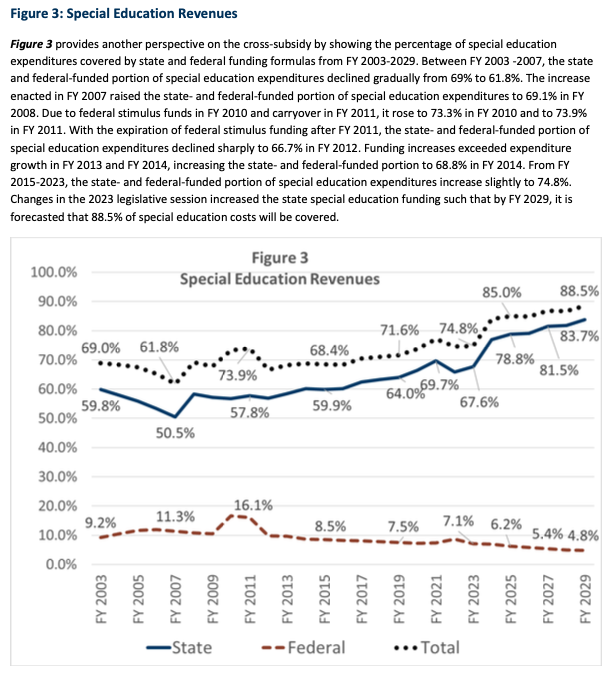
Line graph of state and federal shares of Minnesota special education costs, FY 2003–2029. Total coverage dips to 61.8% in FY 2007, then rises to a projected 88.5% by FY 2029, driven by a growing state share. The federal share declines to 4.8%.