The School Board eliminated the Equity and Inclusion Resolution so tax dollars go to education, not ideology. If that money is back in the classrooms, why do we need a levy?
Whooo boy.
For starters, meeting every student’s needs is exactly what the classroom exists to do. On Day 5, I wrote about how some people shrink the definition of “classroom” until it fits their argument. Diversity, equity, and inclusion (DEI) gets the same treatment. DEI is all about access. It’s the intentional questions teachers and staff ask every day to make sure each student can participate and succeed.
A parent asked me what DEI adds to laws we already have, like the Americans with Disabilities Act (ADA). My answer went back to the example of Every Buddy’s Playground. The playground met legal standards, but not every child could play on it. The fix didn’t take anything away from anyone. It simply made the playground accessible to all kids.
Laws like the ADA are wonderful and absolutely necessary. But laws only set the minimum standard, and that standard is often shaped by compromise. DEI isn’t a new layer on top of them. It’s their evolution, continually raising the bar as we learn who may have been unintentionally left out. Nobody meant to build a playground that excluded certain children. We just need to keep doing better.
There seems to be a fundamental misunderstanding about DEI and who it supports. In a September post on her official School Board Director page, Director Lisa Atkinson asked, “Why is Equity more important than allowing smart kids to excel?” The graphic attached to her post put it more bluntly. “Smart Kids Left Behind.”
That framing assumes this work only serves the most marginalized students, and that everyone else pays the price. In fact, it doesn’t just reduce exclusion. More often than not, it benefits far more people than the group it was originally meant to support.
There’s a name for this: the curb-cut effect. Curb cuts were built for wheelchair users, and now everyone with a stroller, a suitcase, or a bike uses them. A flaw built into our communities created obstacles for certain people. Once it was corrected, it benefited a wider range of people than anyone anticipated.
I also shared my own family’s experience. One of my sons has an IEP and does his best work when the supports around him match what he needs, like help with focus and navigating the school day. Those supports don’t lower expectations. My other son was working on multiplication tables because his teacher recognized he needed a challenge. Both got what they needed because someone asked the right questions.
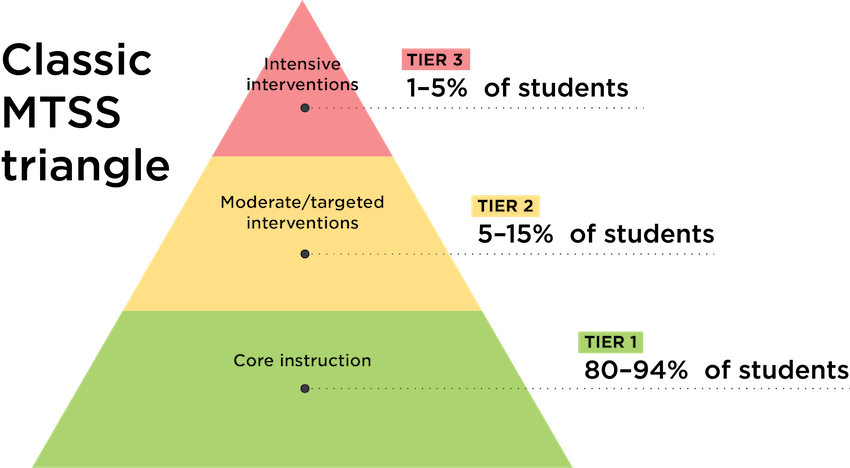
A triangle showing the classic MTSS model. Tier 1 core instruction at the base serves 80 to 94 percent of students. Tier 2 targeted interventions in the middle serve 5 to 15 percent. Tier 3 intensive interventions at the top serve 1 to 5 percent.
Educators have a framework for this called a Multi-Tiered System of Supports (MTSS). The classic version is a triangle. Most students get core instruction, some get targeted help, and a few get intensive intervention. But since the pandemic, more students than ever need extra support, and the triangle no longer matches what teachers see in their classrooms.
A newer model, the MTSS diamond, widens in the middle to reflect that reality. And it runs in both directions. On one side are supports for students who need a little help. On the other are extension and enrichment for students who are ready to move ahead. Researchers at NWEA describe it as “not a hierarchy of deficits, but a continuum of access.”
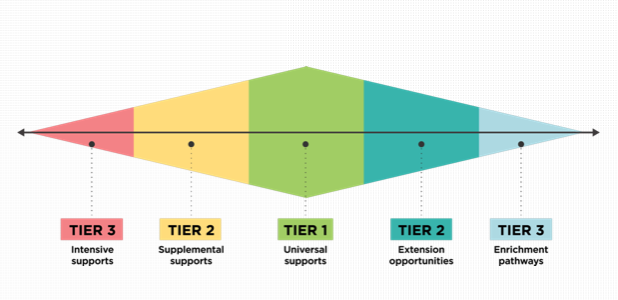
The MTSS diamond runs in both directions, with supports for students who need help on one side and extension and enrichment for students ready to move ahead on the other. Image courtesy of NWEA.
That’s my two sons. They landed on opposite sides of the diamond, and both got exactly what they needed. The tiers describe the help a student gets, not who the student is. It’s the opposite of leaving smart kids behind.
PLSAS doesn’t use the diamond model today, and choosing an instructional framework isn’t a board decision. That work belongs to our administration and educators. But it’s a conversation I’d welcome with them, whether that’s the diamond or other ideas they’re exploring to support every student. Whatever direction they take, it will require the kind of coordination I wrote about on Day 5, and the funding to make it happen.